Crosshatch Check Seamless Patterns 01: A Comprehensive Review
In the landscape of digital design resources, finding textures that offer both structural integrity and visual depth can be challenging. Crosshatch Check Seamless Patterns 01 represents a specific intersection of two distinct graphic elements: the grid-like precision of check patterns and the organic, layered texture of crosshatching. This collection is designed to provide designers, illustrators, and crafters with versatile assets that bridge the gap between rigid geometry and hand-drawn aesthetics.
This review evaluates the utility, technical specifications, and potential applications of this pattern set. It aims to help professionals and hobbyists determine whether these assets align with their current project requirements or if alternative solutions might better serve their needs.
Understanding the Design Concept
To evaluate the value of Crosshatch Check Seamless Patterns 01, it is necessary to first understand the visual language it employs. Traditional check patterns are defined by intersecting horizontal and vertical lines that create squares or rectangles. While effective for backgrounds or clothing textiles, they can sometimes appear flat or overly simplistic in modern digital contexts.
Crosshatching, conversely, involves using closely spaced parallel lines that cross over one another at angles to create shading and texture. When combined, these techniques result in a pattern that retains the orderliness of a grid while introducing the visual noise and richness associated with hand-drawn illustrations. The "seamless" nature of these patterns means they can be tiled infinitely without visible breaks, making them suitable for large-scale applications such as website backgrounds, fabric prints, or packaging design.
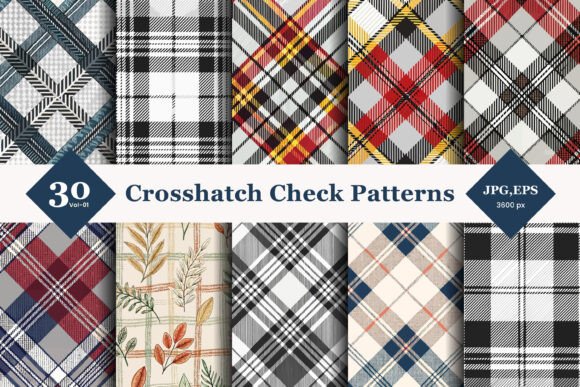
The collection comprises 30 unique variations. This quantity allows for significant flexibility, enabling users to mix and match different densities, line weights, and orientations within a single cohesive project. The amalgamation of structured appeal and rich texture ensures that the designs remain visually captivating without overwhelming the primary content they support.
Technical Specifications and Workflow Integration
A critical factor in selecting digital assets is file compatibility and resolution. Crosshatch Check Seamless Patterns 01 addresses common workflow bottlenecks by providing files in both EPS (Encapsulated PostScript) and JPG formats. Understanding the distinction between these formats is essential for maximizing the utility of the purchase.
Vector Scalability with EPS Files
The inclusion of high-resolution EPS vector files is a significant advantage for professional workflows. Vector graphics are mathematically defined, meaning they can be resized to any dimension—from a small icon to a billboard—without losing quality or introducing pixelation. For designers working on print projects, such as business cards, brochures, or large-format banners, this format ensures crisp edges and clean lines. It also allows for easy color manipulation; users can alter the stroke colors or background hues directly within vector editing software like Adobe Illustrator or Affinity Designer.
Raster Precision with JPG Files
The accompanying JPG files are provided at 300 DPI (dots per inch). This resolution is considered the standard for high-quality printing. These raster images are ideal for use in programs that do not handle vectors well, or for quick mockups where precise editing is not required. They are also suitable for web use, although compression artifacts should be monitored when scaling down for smaller screens.
Applications and Use Cases
The versatility of Crosshatch Check Seamless Patterns 01 makes it applicable across several creative disciplines. Below are specific scenarios where these patterns demonstrate strong utility.
- Digital Art and UI Design: Web designers often struggle with creating engaging backgrounds that do not distract from content. These patterns provide a subtle texture that adds depth to user interfaces. The seamless tiling ensures that the background remains consistent across different screen sizes.
- Fabric and Textile Design: Fashion designers and textile artists can utilize these patterns for apparel, home decor, or accessories. The crosshatch element mimics woven fabrics, lending an authentic feel to digital prints intended for physical production.
- Print Media: Due to the 300 DPI resolution and vector availability, these patterns are well-suited for magazines, posters, and packaging. The high contrast and structured lines reproduce well on various paper stocks.
- Crafting and Scrapbooking: Hobbyists who create custom stationery or scrapbook pages can use these patterns to add a sophisticated touch to personal projects. The instant download feature facilitates quick access for last-minute creative endeavors.
Evaluating Benefits and Tradeoffs
While the asset offers numerous advantages, a balanced evaluation requires considering potential limitations and tradeoffs.
Benefits
- Versatility: The dual format support caters to both vector-based and raster-based workflows.
- Consistency: With 30 unique but stylistically related patterns, users can maintain visual consistency across multi-page documents or complex compositions.
- Efficiency: Instant download eliminates waiting times, allowing projects to move forward immediately.
Considerations and Limitations
One consideration is the aesthetic specificity. Crosshatch checks are a distinct style that may not suit every brand identity. Projects requiring soft, watercolor-like textures or photorealistic elements will find these geometric patterns inappropriate. Additionally, while the patterns are seamless, integrating them into a design still requires skill in layering and opacity adjustment to ensure they enhance rather than compete with foreground elements.
Another minor limitation is the reliance on monochrome or limited color palettes inherent to crosshatching. While users can recolor the vectors, the fundamental design relies on line density to convey texture. This may restrict its use in highly colorful or vibrant design themes unless heavily modified.
Decision-Making Insights
When deciding whether to incorporate Crosshatch Check Seamless Patterns 01 into your workflow, consider the following questions:
- Do you need scalable graphics? If your project involves printing at large sizes, the EPS files are indispensable. If you only need small-screen thumbnails, the JPGs suffice.
- Is the aesthetic appropriate? Evaluate if the structured yet textured look aligns with your brand’s voice. These patterns work best in modern, minimalist, or industrial-themed designs.
- Are you looking for variety? With 30 options, the set provides ample choice. However, if you require highly diverse styles (e.g., floral, abstract, photographic), this set may be too narrow in scope.
For users seeking a reliable, high-quality texture pack that bridges the gap between digital precision and artistic texture, this collection is a strong candidate. The combination of vector scalability and high-resolution raster options ensures that most design challenges can be met effectively.
Conclusion
Crosshatch Check Seamless Patterns 01 offers a practical solution for creatives seeking to add depth and structure to their work. By combining the reliability of checkered grids with the nuance of crosshatching, it provides a unique visual toolset. The inclusion of both EPS and JPG formats at 300 DPI ensures compatibility with a wide range of software and output methods. Whether used for digital backgrounds, textile prints, or print media, these patterns deliver professional-grade results. Users who prioritize versatility, quality, and immediate accessibility will likely find this resource valuable for enhancing their creative projects.